

Digital Terrestrial Television Market Insights Opportunities and Competitive Landscape
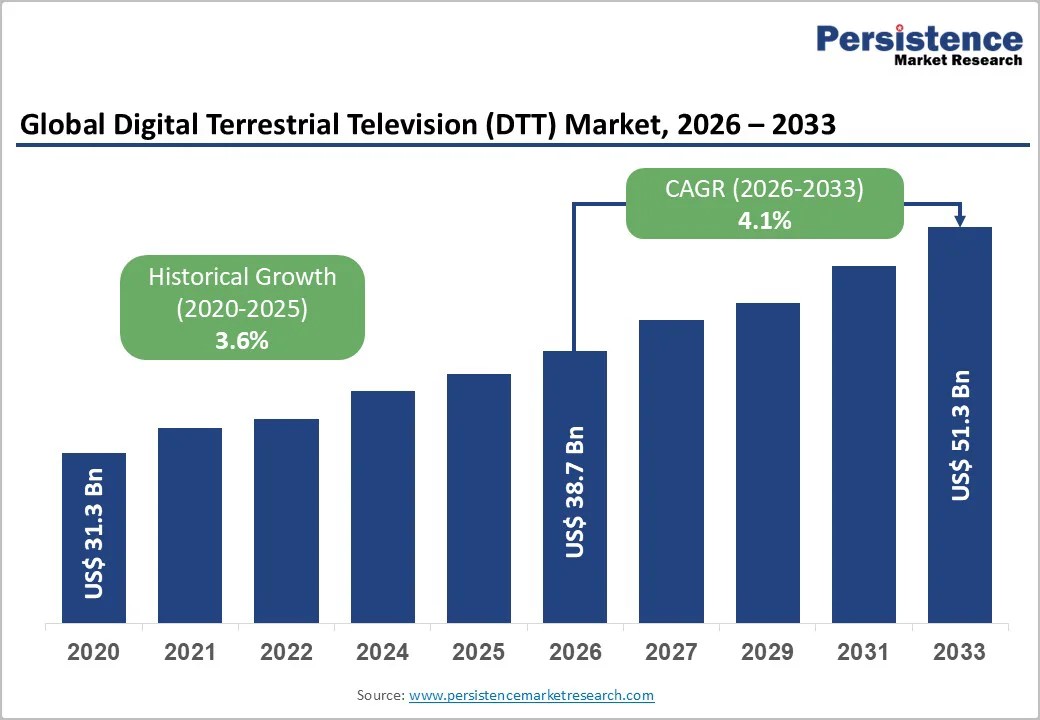
Digital terrestrial TV market grows from US$38.74 Bn in 2026 to US$51.3 Bn by 2033 as countries expand digital broadcasting and improve spectrum efficiency.
BRENTFORD, ENGLAND, UNITED KINGDOM, February 4, 2026 /EINPresswire.com/ -- The Digital Terrestrial Television (DTT) market represents a critical pillar of the global broadcasting ecosystem, enabling free-to-air television services through digital signals transmitted over terrestrial networks. Unlike satellite or cable TV, DTT offers cost-effective access to high-quality television content, making it a preferred choice for governments and consumers alike. Its relevance remains strong, particularly in regions prioritizing universal access to information and public broadcasting services.
From a market size perspective, the global digital terrestrial television market is projected to reach US$38.74 billion in 2026 and expand further to US$51.3 billion by 2033, registering a CAGR of 4.1% between 2026 and 2033. This steady growth reflects the continued momentum of analog switch-off mandates, rising penetration of HD and UHD televisions, and sustained investments in next-generation broadcasting standards. While the market is mature in several developed economies, emerging regions continue to unlock new demand through digital transformation initiatives.
𝐆𝐞𝐭 𝐚 𝐒𝐚𝐦𝐩𝐥𝐞 𝐏𝐃𝐅 𝐁𝐫𝐨𝐜𝐡𝐮𝐫𝐞 𝐨𝐟 𝐭𝐡𝐞 𝐑𝐞𝐩𝐨𝐫𝐭: https://www.persistencemarketresearch.com/samples/21586
Market Dynamics, Growth Drivers, and Leading Segments
Government-mandated analog-to-digital transitions remain the single most influential growth driver for the DTT market. National policies aimed at efficient spectrum utilization, enhanced broadcast quality, and expanded channel capacity have accelerated DTT deployment worldwide. In parallel, increasing consumer demand for high-definition and ultra-high-definition content has strengthened the case for advanced DTT technologies that deliver superior picture quality without subscription costs.
In terms of segmentation, DVB-T/T2 technology leads the market with an estimated 55% share in 2026, owing to its proven reliability, efficient spectrum usage, and ability to support multi-channel HD broadcasting. Geographically, North America dominates the global DTT market, accounting for approximately 45% market share, driven by advanced telecom infrastructure, early adoption of next-generation standards, and strong demand for targeted, high-quality broadcasting services.
Digital Terrestrial Television Market Segmentation Analysis
The digital terrestrial television market is segmented primarily by technology type, including DVB-T, DVB-T2, ATSC, ISDB-T, and DTMB. Among these, DVB-T and DVB-T2 account for the largest share due to widespread adoption across Europe, Africa, and parts of Asia. Their backward compatibility, cost efficiency, and robust ecosystem of compatible receivers have reinforced their long-term relevance in both developed and developing markets.
From an end-user and application perspective, the market serves residential households, public broadcasters, private broadcasters, and government communication networks. Residential users represent the largest segment, driven by the affordability of free-to-air services and the growing availability of digital TV sets. Meanwhile, broadcasters increasingly leverage DTT platforms for regional content distribution, emergency alerts, and public service broadcasting, further strengthening the market’s structural demand.
Regional Insights and Market Performance
North America continues to lead the digital terrestrial television market, supported by early digitization, strong regulatory frameworks, and the rapid adoption of ATSC 3.0. The region’s focus on interactive services, targeted advertising, and UHD broadcasting has positioned it at the forefront of technological innovation within the DTT ecosystem.
Asia Pacific, on the other hand, is emerging as the fastest-growing regional market. Countries across South and Southeast Asia are accelerating digital policy reforms, reallocating spectrum, and investing in terrestrial broadcast infrastructure. Rising demand for localized content in native languages, coupled with expanding urban populations, is significantly boosting DTT adoption across the region.
𝐃𝐨 𝐘𝐨𝐮 𝐇𝐚𝐯𝐞 𝐀𝐧𝐲 𝐐𝐮𝐞𝐫𝐲 𝐎𝐫 𝐒𝐩𝐞𝐜𝐢𝐟𝐢𝐜 𝐑𝐞𝐪𝐮𝐢𝐫𝐞𝐦𝐞𝐧𝐭? 𝐑𝐞𝐪𝐮𝐞𝐬𝐭 𝐂𝐮𝐬𝐭𝐨𝐦𝐢𝐳𝐚𝐭𝐢𝐨𝐧 𝐨𝐟 𝐑𝐞𝐩𝐨𝐫𝐭: https://www.persistencemarketresearch.com/request-customization/21586
Market Drivers Supporting Industry Growth
One of the primary drivers of the digital terrestrial television market is the global push for spectrum efficiency. Digital broadcasting allows governments to free up valuable spectrum for mobile broadband and 5G services while maintaining essential television coverage. This dual benefit has made DTT a strategic priority in national telecom and media policies.
Additionally, increasing affordability of digital television receivers and set-top boxes has lowered entry barriers for consumers. As hardware costs decline and content quality improves, DTT continues to attract households seeking reliable, subscription-free entertainment solutions, especially in price-sensitive markets.
Market Restraints Limiting Expansion
Despite its advantages, the DTT market faces growing competition from over-the-top (OTT) streaming platforms and IPTV services. The shift toward on-demand, personalized content consumption has reduced traditional broadcast viewership in some urban and digitally mature markets, posing a challenge to long-term growth.
Infrastructure upgrade costs also act as a restraint, particularly in developing regions. Deploying and maintaining advanced DTT networks requires substantial capital investment, which can strain public budgets and slow adoption in economically constrained markets.
Market Opportunities and Future Outlook
The transition toward next-generation broadcast standards such as ATSC 3.0 presents significant growth opportunities. These technologies enable interactive features, immersive audio, targeted advertising, and hybrid broadcast-broadband services, opening new revenue streams for broadcasters and advertisers.
Moreover, the integration of DTT with emergency alert systems and public safety communications enhances its strategic value. As governments prioritize resilient communication infrastructure, digital terrestrial television is expected to play a crucial role in disaster preparedness and national information dissemination frameworks.
Reasons to Buy the Digital Terrestrial Television Market Report
✔ Gain in-depth insights into global and regional market size trends through 2033.
✔ Understand key growth drivers, restraints, and emerging opportunities shaping the DTT market.
✔ Analyze technology-wise and region-wise performance with detailed forecasts.
✔ Identify leading players and their strategic initiatives within the industry.
✔ Support data-driven decision-making for investments, partnerships, and market entry strategies.
𝐁𝐮𝐲 𝐍𝐨𝐰 𝐭𝐡𝐞 𝐃𝐞𝐭𝐚𝐢𝐥𝐞𝐝 𝐑𝐞𝐩𝐨𝐫𝐭: https://www.persistencemarketresearch.com/checkout/21586
Company Insights
Samsung Electronics Co., Ltd.
Sony Group Corporation
LG Electronics Inc.
Panasonic Corporation
Rohde & Schwarz GmbH & Co KG
NEC Corporation
Harmonic Inc.
Evertz Microsystems Ltd.
Recent Developments:
Broadcasters in North America have accelerated ATSC 3.0 rollouts to support UHD and interactive services.
Several Asia Pacific governments announced new digital broadcasting initiatives aligned with spectrum modernization programs.
Related Reports:
Programmable Logic Controller Market
Pooja Gawai
Persistence Market Research
+1 646-878-6329
email us here
Visit us on social media:
LinkedIn
Instagram
Facebook
YouTube
Legal Disclaimer:
EIN Presswire provides this news content "as is" without warranty of any kind. We do not accept any responsibility or liability for the accuracy, content, images, videos, licenses, completeness, legality, or reliability of the information contained in this article. If you have any complaints or copyright issues related to this article, kindly contact the author above.
