

EU Taurine Market Outlook Hits USD 145.73 Million by 2036 | Ajinomoto, Kyowa Hakko, Qianjiang Lead Growth
Taurine Market in EU
EU taurine demand grows steadily, driven by supplements, energy drinks, and pharma use, supported by B2B supply chains and strict regulations.
NEWARK, DE, UNITED STATES, April 2, 2026 /EINPresswire.com/ -- Future Market Insights (FMI) projects that the Demand for Taurine in EU is entering a steady expansion phase, driven by rising utilization across dietary supplements, energy beverages, and pharmaceutical formulations. Increasing emphasis on functional nutrition, clinically supported amino acid supplementation, and regulatory compliance is shaping a structured, B2B-driven growth environment across the European taurine ecosystem.
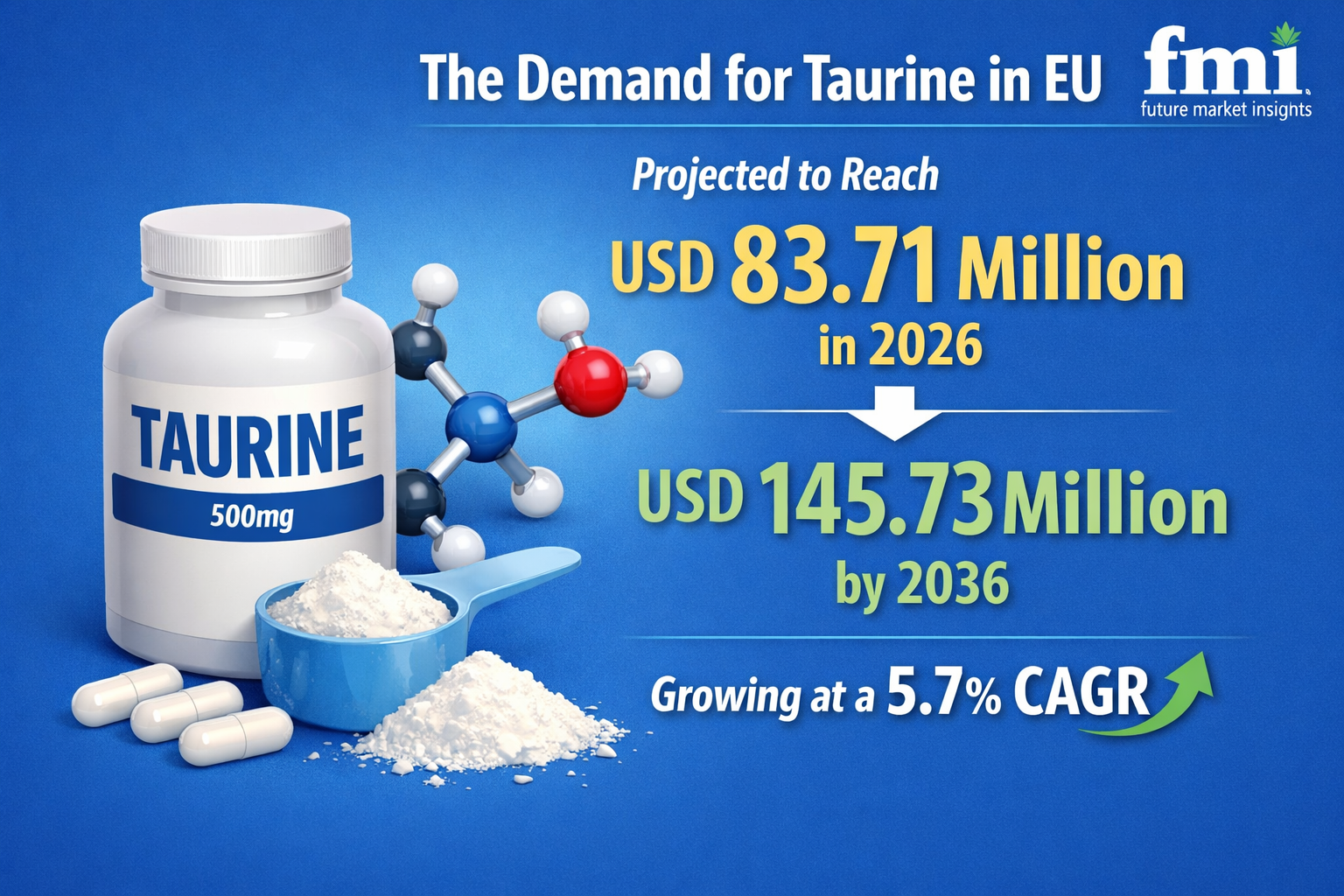
In 2025, the EU taurine market was valued at USD 79.20 million. According to FMI, demand is expected to reach USD 83.71 million in 2026 and further expand to USD 145.73 million by 2036, progressing at a CAGR of 5.7% during the forecast period.
The projected incremental opportunity of USD 62.0 million highlights sustained growth supported by dual-channel demand from energy beverage formulators and dietary supplement manufacturers, alongside premium expansion in pharmaceutical-grade taurine applications.
Request Your Sample Now - Unlock Growth Potential and Discover Key Market Opportunities! https://www.futuremarketinsights.com/reports/sample/rep-gb-27203
Demand for Taurine in EU Market Snapshot
• Market Value (2025): USD 79.20 Million
• Forecast Value (2036): USD 145.73 Million
• Forecast CAGR (2026–2036): 5.7%
• Leading Segment: Food Grade (48.0%)
• Top Application: Dietary Supplements (24.0%)
• Dominant Channel: B2B Distribution (97.0%)
B2B-Centric Supply Chain and Synthetic Dominance Driving Market Structure
A defining characteristic of the EU taurine market is its B2B-centric distribution model, where ingredient supply chains are tightly integrated with food, beverage, nutraceutical, and pharmaceutical manufacturers. Approximately 97.0% of taurine demand flows through B2B channels, reflecting the ingredient’s role as a functional input rather than a consumer-facing product.
Synthetic taurine dominates the market with a 96.0% share, supported by cost efficiency, scalability, and consistency in achieving pharmaceutical-grade purity. Pricing structures remain closely linked to Asian manufacturing benchmarks, particularly Chinese production, while EU import compliance and regulatory frameworks define market entry barriers.
Dietary Supplements and Energy Beverages Anchor Demand Growth
By application, dietary supplements account for 24.0% of total demand in 2026, maintaining leadership as taurine continues to play a critical role in energy metabolism, cardiovascular support, and antioxidant formulations.
Taurine demand is strongly supported across:
• Functional dietary supplements
• Energy and sports beverages
• Pharmaceutical formulations
• Animal nutrition products
Energy beverage manufacturers remain one of the largest bulk consumers, while pharmaceutical-grade taurine provides a premium-priced niche segment with higher regulatory and purity requirements.
Food-Grade Taurine Leads Product Segment with Broad Industrial Adoption
By grade, the food-grade segment holds a dominant 48.0% share in 2026, driven by its versatility, solubility, and compatibility across beverages, supplements, and fortified foods.
Manufacturers prefer food-grade taurine due to:
• Stable formulation performance
• Compatibility with liquid and powder applications
• Strong regulatory acceptance across EU markets
Meanwhile, pharmaceutical-grade taurine continues to expand as clinical applications gain traction, offering higher margins and specialized demand.
Netherlands and Spain Emerge as High-Growth Markets
Regionally, the EU market reflects differentiated growth trajectories led by distribution hubs and manufacturing centers.
Demand for Taurine in EU Growth by Country (2026–2036)
• Netherlands: 6.2%
• Rest of Europe: 6.1%
• Spain: 6.0%
• Italy: 5.9%
• France: 5.8%
• Germany: 5.4%
The Netherlands leads growth due to its role as a key import, distribution, and re-export hub, supported by strong logistics infrastructure and regulatory clarity. Spain follows closely, driven by rapid expansion in energy beverages and sports nutrition.
Germany, while growing at a moderate pace, remains the largest demand center, supported by its advanced pharmaceutical and nutraceutical manufacturing ecosystem.
Regulatory Compliance and Quality Standards Shaping Competitive Dynamics
The EU taurine market operates under strict regulatory oversight, including Regulation (EC) No 1333/2008 and the Food Supplements Directive 2002/46/EC, which define usage limits, labeling requirements, and safety standards.
EFSA risk assessments play a crucial role in determining acceptable intake levels, influencing formulation strategies across food and supplement applications.
This regulatory environment is driving demand for:
• High-purity, certified taurine
• GMP-compliant manufacturing
• Verified traceability and documentation
Emerging Trends: Bio-Fermentation and Clean-Label Taurine
A key trend shaping the market is the shift toward bio-fermentation-derived taurine, enabling sustainable, plant-based production alternatives to synthetic processes.
These innovations offer:
• Reduced environmental impact
• Improved traceability
• Alignment with clean-label and sustainability trends
Although still a niche segment, bio-based taurine is gaining traction among premium nutraceutical and pharmaceutical manufacturers.
Competitive Landscape Focused on Purity, Sustainability, and Supply Reliability
The EU taurine market is moderately consolidated, with competition centered on purity optimization, regulatory compliance, and supply chain reliability.
Key players operating in the market include:
• Ajinomoto Co., Inc.
• Kyowa Hakko Bio Co., Ltd.
• Qianjiang Yongan Pharmaceutical Co. Ltd.
• The Honjo Chemical Corporation
• Foodchem International Corporation
• Stauber USA
These companies are investing in bio-fermentation technologies, European distribution networks, and pharmaceutical-grade production capabilities to strengthen their competitive positioning.
Market Outlook: Functional Nutrition and Pharmaceutical Integration to Sustain Growth
The future outlook for the EU taurine market remains stable and opportunity-driven as functional nutrition, energy beverage innovation, and pharmaceutical applications continue to expand.
Manufacturers are increasingly focusing on:
• High-purity taurine with validated bioavailability
• Sustainable and clean-label production methods
• Integration into functional foods and clinical formulations
As European consumers continue to prioritize performance nutrition, cardiovascular health, and metabolic wellness, taurine is expected to remain a critical amino acid ingredient supporting long-term growth across nutraceutical, beverage, and pharmaceutical industries through 2036.
Browse More Reports from Food and Beverages:
Agriculture Enzyme Market: https://www.futuremarketinsights.com/reports/agricultural-enzymes-market
Savory Ingredient Market: https://www.futuremarketinsights.com/reports/savory-ingredient-market
Potato Protein Isolate Market: https://www.futuremarketinsights.com/reports/potato-protein-issolate-market
Ice Cream and Frozen Dessert Market: https://www.futuremarketinsights.com/reports/ice-cream-and-frozen-dessert-market
Sudip Saha
Future Market Insights Inc.
+1 347-918-3531
email us here
Legal Disclaimer:
EIN Presswire provides this news content "as is" without warranty of any kind. We do not accept any responsibility or liability for the accuracy, content, images, videos, licenses, completeness, legality, or reliability of the information contained in this article. If you have any complaints or copyright issues related to this article, kindly contact the author above.
