

Fishmeal Market Heads Toward USD 12.078 Billion by 2034 as Feed Innovation Accelerates Growth at 4.0% CAGR
Fishmeal Market Report 2026
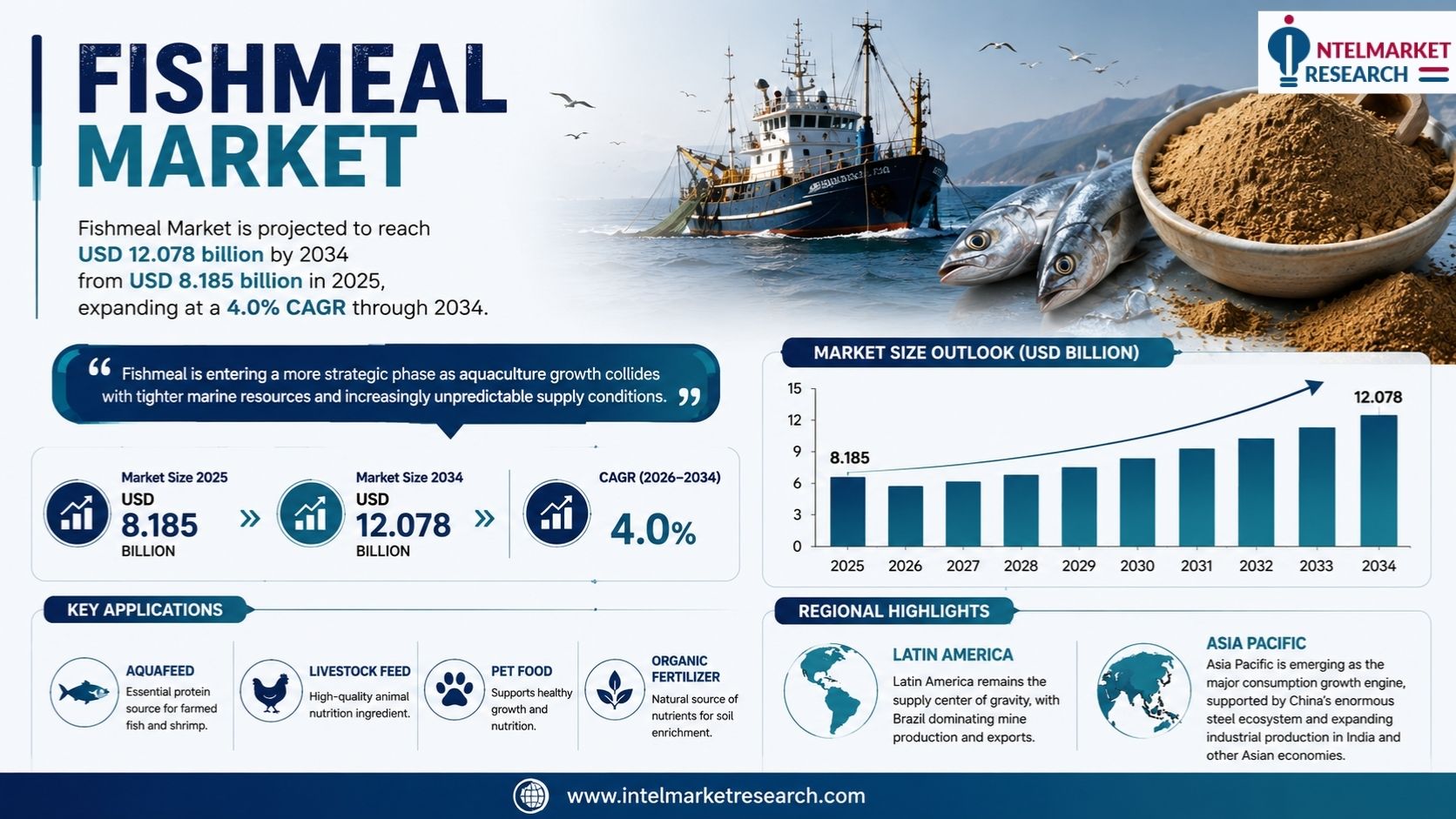
Fishmeal Market is projected to reach USD 12.078 billion by 2034 from USD 8.185 billion in 2025, expanding at a 4.0% CAGR through 2034.
Fishmeal is entering a more strategic phase as aquaculture growth collides with tighter marine resources and increasingly unpredictable supply conditions.”
PUNE, MAHARASHTRA, INDIA, August 27, 2026 /EINPresswire.com/ -- Fishmeal Market is entering 2026 under a very different set of conditions from the relatively balanced supply environment seen in parts of the previous year. Fishmeal remains a critical protein-rich ingredient for aquaculture and selected animal-feed applications, but its market dynamics are becoming increasingly connected to ocean conditions, fishing quotas, aquaculture economics, feed formulation and international sourcing risk.— IntelMarketResearch
The latest developments are particularly significant because supply has tightened at the same time that aquaculture continues to expand.
◘ According to the Food and Agriculture Organization of the United Nations (FAO), global aquaculture production of aquatic animals exceeded 100 million tonnes for the first time in 2024, reinforcing the structural importance of feed ingredients to the rapidly expanding farmed-aquatic-food sector.
At the same time, FAO's GLOBEFISH analysis reported that global fishmeal and fish-oil supplies were tighter in the first half of 2026 than at any point since the El Nino disruption of 2023.
This combination is creating a market where availability, quality and sourcing reliability are becoming as important as consumption growth.
𝐒𝐞𝐠𝐦𝐞𝐧𝐭 𝐈𝐧𝐭𝐞𝐥𝐥𝐢𝐠𝐞𝐧𝐜𝐞 𝐎𝐯𝐞𝐫𝐯𝐢𝐞𝐰:
➢ 𝐓𝐲𝐩𝐞
• Steam Dried (SD) (Premium Quality Preference)
• Flame Dried (FD)
𝗞𝗲𝘆 𝗶𝗻𝘀𝗶𝗴𝗵𝘁: Steam-dried fishmeal remains preferred for premium feed formulations because controlled drying better preserves protein quality and nutritional value.
➢ 𝐀𝐩𝐩𝐥𝐢𝐜𝐚𝐭𝐢𝐨𝐧
• Aquaculture Feed (Fastest-Growing Demand Center)
• Poultry Feed
• Pig Feed
• Pet Food
𝗞𝗲𝘆 𝗶𝗻𝘀𝗶𝗴𝗵𝘁: Aquaculture feed is driving incremental demand as salmon, shrimp and other high-value farmed species require highly digestible marine protein.
➢ 𝐄𝐧𝐝 𝐔𝐬𝐞𝐫
• Commercial Feed Manufacturers (Largest Purchasing Base)
• Integrated Aquaculture Producers
• Pet Food Companies
𝗞𝗲𝘆 𝗶𝗻𝘀𝗶𝗴𝗵𝘁: Commercial feed manufacturers lead purchasing because their large-scale production requires consistent fishmeal quality, specifications and dependable supply.
➢ 𝐒𝐨𝐮𝐫𝐜𝐞 𝐌𝐚𝐭𝐞𝐫𝐢𝐚𝐥
• Whole Fish
• Fish By-Products (Sustainability-Focused Growth Segment)
• Trimmings
𝗞𝗲𝘆 𝗶𝗻𝘀𝗶𝗴𝗵𝘁: Fish by-products are gaining importance as processors increase resource utilization, reduce waste and convert seafood-processing residues into valuable feed ingredients.
➢ 𝐐𝐮𝐚𝐥𝐢𝐭𝐲 𝐆𝐫𝐚𝐝𝐞
• Premium Grade (Highest-Value Segment)
• Standard Grade
• Feed Grade
𝗞𝗲𝘆 𝗶𝗻𝘀𝗶𝗴𝗵𝘁: Premium-grade fishmeal commands stronger interest in high-performance aquaculture because of its protein quality, amino-acid profile and suitability for sensitive growth stages.
🔶𝐄𝐱𝐩𝐥𝐨𝐫𝐞 𝐎𝐮𝐫 𝐈𝐧-𝐃𝐞𝐩𝐭𝐡 𝐒𝐚𝐦𝐩𝐥𝐞 𝐑𝐞𝐩𝐨𝐫𝐭 𝐈𝐧𝐬𝐢𝐠𝐡𝐭𝐬: https://www.intelmarketresearch.com/download-free-sample/21403/fishmeal-market
The Competitive Race Is Moving Toward Supply Security and Marine-Ingredient Quality
The fishmeal industry has a different competitive structure from many manufactured food-ingredient markets because access to raw fish, fishing quotas, processing infrastructure and sustainability credentials can be as important as production technology.
𝐋𝐢𝐬𝐭 𝐨𝐟 𝐊𝐞𝐲 𝐅𝐢𝐬𝐡𝐦𝐞𝐚𝐥 𝐂𝐨𝐦𝐩𝐚𝐧𝐢𝐞𝐬 𝐏𝐫𝐨𝐟𝐢𝐥𝐞𝐝
💠TASA
💠Diamante
💠Austevoll Seafood ASA
💠COPEINCA
💠Corpesca SA
💠Omega Protein
💠Coomarpes
💠KT Group
💠Cermaq
💠FF Skagen
💠Austral
💠Kodiak Fishmeal
💠Havsbrun
💠Hayduk
💠Exalmar
European producers differentiate themselves through processing efficiency, traceability and access to diverse raw-material sources. FF Skagen, for example, operates a modern processing facility directly at the Skagen quayside and receives raw material from Danish and foreign fishing vessels.
The competitive picture is also changing as sustainability becomes part of procurement decisions. Suppliers capable of demonstrating responsible sourcing, traceability and consistent quality can command stronger relationships with multinational feed manufacturers.
Competitive takeaway: The strongest fishmeal producers are increasingly competing on four fronts simultaneously: raw-material access, nutritional consistency, sustainability credentials and dependable global supply.
𝐂𝐥𝐢𝐦𝐚𝐭𝐞 𝐑𝐢𝐬𝐤 𝐈𝐬 𝐁𝐞𝐜𝐨𝐦𝐢𝐧𝐠 𝐚 𝐏𝐫𝐢𝐜𝐢𝐧𝐠 𝐕𝐚𝐫𝐢𝐚𝐛𝐥𝐞
o In August 2026, IFFO reported that Coastal El Niño conditions were affecting marine-ingredient production by reducing raw-material availability in Peru and Chile, while weaker availability was also expected across parts of Northern Europe and Asia. This makes climate variability an increasingly important consideration for procurement teams.
For fishmeal producers and buyers, the traditional question of “𝗛𝗼𝘄 𝗺𝘂𝗰𝗵 𝗰𝗮𝗻 𝗯𝗲 𝗽𝗿𝗼𝗱𝘂𝗰𝗲𝗱?” is increasingly being replaced by:
“𝗛𝗼𝘄 𝗿𝗲𝗹𝗶𝗮𝗯𝗹𝘆 𝗰𝗮𝗻 𝗿𝗮𝘄 𝗺𝗮𝘁𝗲𝗿𝗶𝗮𝗹 𝗯𝗲 𝘀𝗲𝗰𝘂𝗿𝗲𝗱 𝘂𝗻𝗱𝗲𝗿 𝗰𝗵𝗮𝗻𝗴𝗶𝗻𝗴 𝗼𝗰𝗲𝗮𝗻 𝗰𝗼𝗻𝗱𝗶𝘁𝗶𝗼𝗻𝘀?”
That distinction could influence contract structures, inventory strategies, sourcing diversification and price negotiations across the industry.
🔶𝐀𝐜𝐜𝐞𝐬𝐬 𝐭𝐡𝐞 𝐅𝐮𝐥𝐥 𝐑𝐞𝐩𝐨𝐫𝐭 𝐟𝐨𝐫 𝐈𝐧-𝐃𝐞𝐩𝐭𝐡 𝐈𝐧𝐬𝐢𝐠𝐡𝐭𝐬: https://www.intelmarketresearch.com/fishmeal-market-21403
𝐂𝐡𝐢𝐧𝐚 𝐈𝐬 𝐓𝐮𝐫𝐧𝐢𝐧𝐠 𝐢𝐧𝐭𝐨 𝐭𝐡𝐞 𝐃𝐞𝐦𝐚𝐧𝐝-𝐒𝐢𝐝𝐞 𝐏𝐫𝐞𝐬𝐬𝐮𝐫𝐞 𝐏𝐨𝐢𝐧𝐭
• While Peru represents a major supply-side variable, China is increasingly important on the demand side.
• China's aquaculture and aquafeed sectors are creating a powerful pull on marine ingredients. IFFO reported that domestic aquafeed production increased year-on-year during early 2026 and expected first-quarter fishmeal demand, particularly in southern China, to show solid growth.
• More recent industry reporting indicates that China's aquafeed production reached 11.1 million tonnes during the first half of 2026, up 17.4% year-on-year, while aquaculture production also increased during the same period.
• This is significant because China is not simply a major consumer of fishmeal it is a key market through which global aquaculture expansion translates into international marine-ingredient demand.
𝐑𝐞𝐠𝐢𝐨𝐧𝐚𝐥 𝐀𝐧𝐚𝐥𝐲𝐬𝐢𝐬:
➣ 𝐀𝐬𝐢𝐚 𝐏𝐚𝐜𝐢𝐟𝐢𝐜 | 𝐓𝐡𝐞 𝐃𝐞𝐦𝐚𝐧𝐝 𝐄𝐧𝐠𝐢𝐧𝐞 𝐈𝐬 𝐒𝐢𝐭𝐭𝐢𝐧𝐠 𝐂𝐥𝐨𝐬𝐞 𝐭𝐨 𝐭𝐡𝐞 𝐀𝐪𝐮𝐚𝐜𝐮𝐥𝐭𝐮𝐫𝐞 𝐅𝐚𝐫𝐦𝐬
Asia Pacific represents the most important consumption ecosystem because it combines large aquaculture industries with major feed manufacturing capacity.
China is particularly significant. FAO reported that China accounted for 40% of global fishmeal imports in 2024, making it by far the world's largest importing market.
China's domestic fishmeal production has faced pressure from fishing restrictions and raw-material availability. IFFO estimated that China's marine-ingredient production in 2025 could fall 𝟮𝟬% 𝘁𝗼 𝟯𝟬% 𝗯𝗲𝗹𝗼𝘄 𝟮𝟬𝟮𝟰 𝗹𝗲𝘃𝗲𝗹𝘀, increasing reliance on imports from suppliers including Peru, Vietnam and Chile.
Japan, Vietnam, Thailand and Indonesia add further demand through aquaculture and feed production.
⁍ 𝗥𝗲𝗴𝗶𝗼𝗻𝗮𝗹 𝘁𝗮𝗸𝗲𝗮𝘄𝗮𝘆: Asia Pacific is the strongest consumption center because expanding aquaculture creates sustained demand for both standard and premium marine-protein ingredients.
➣ 𝐒𝐨𝐮𝐭𝐡 𝐀𝐦𝐞𝐫𝐢𝐜𝐚 | 𝐏𝐞𝐫𝐮 𝐑𝐞𝐦𝐚𝐢𝐧𝐬 𝐭𝐡𝐞 𝐒𝐮𝐩𝐩𝐥𝐲-𝐒𝐢𝐝𝐞 𝐏𝐨𝐰𝐞𝐫𝐡𝐨𝐮𝐬𝐞
South America occupies a unique position because Peru is one of the world's most important fishmeal-producing countries.
In 2024, Peru's improved anchoveta catches helped drive a 26% increase in cumulative fishmeal production across countries tracked by IFFO compared with 2023.
Chile is another important producer, while Ecuador has a growing connection to the broader aquaculture and marine-ingredient ecosystem.
The region's influence therefore extends beyond local consumption. Changes in fishing conditions, quotas and season timing can affect buyers and feed producers thousands of kilometers away.
⁍ 𝗥𝗲𝗴𝗶𝗼𝗻𝗮𝗹 𝘁𝗮𝗸𝗲𝗮𝘄𝗮𝘆: South America functions primarily as a strategic supply base, with Peru's anchoveta cycle playing an outsized role in global fishmeal availability.
➣ 𝐄𝐮𝐫𝐨𝐩𝐞 | 𝐏𝐫𝐞𝐦𝐢𝐮𝐦 𝐏𝐫𝐨𝐜𝐞𝐬𝐬𝐢𝐧𝐠 𝐚𝐧𝐝 𝐓𝐫𝐚𝐜𝐞𝐚𝐛𝐢𝐥𝐢𝐭𝐲 𝐃𝐞𝐟𝐢𝐧𝐞 𝐭𝐡𝐞 𝐌𝐚𝐫𝐤𝐞𝐭
Europe has a mature marine-ingredients industry supported by established fishing fleets, advanced processing facilities and sophisticated feed manufacturers.
Denmark, Norway, Iceland, the United Kingdom and Spain are important parts of the regional ecosystem. European producers increasingly compete through traceability, processing efficiency and responsible sourcing rather than simply maximizing output.
The region is also important for premium aquaculture feed, where consistent ingredient specifications and certification can carry substantial commercial value.
⁍ 𝗥𝗲𝗴𝗶𝗼𝗻𝗮𝗹 𝘁𝗮𝗸𝗲𝗮𝘄𝗮𝘆: Europe's competitive strength lies in processing expertise, traceability and high-specification marine ingredients rather than sheer production volume.
➣ 𝐍𝐨𝐫𝐭𝐡 𝐀𝐦𝐞𝐫𝐢𝐜𝐚 | 𝐒𝐩𝐞𝐜𝐢𝐚𝐥𝐭𝐲 𝐅𝐞𝐞𝐝 𝐀𝐩𝐩𝐥𝐢𝐜𝐚𝐭𝐢𝐨𝐧𝐬 𝐒𝐮𝐬𝐭𝐚𝐢𝐧 𝐃𝐞𝐦𝐚𝐧𝐝
North America represents a mature but diversified fishmeal market serving aquaculture, pet food, and livestock feed and specialty nutrition.
The United States has its own marine-ingredient production base, including menhaden-derived products, while imports supplement domestic requirements. Demand is increasingly influenced by aquaculture expansion and premium animal nutrition.
The region also places strong emphasis on ingredient traceability, regulatory compliance and sustainability documentation.
⁍ 𝗥𝗲𝗴𝗶𝗼𝗻𝗮𝗹 𝘁𝗮𝗸𝗲𝗮𝘄𝗮𝘆: North America's opportunity is centered on specialty nutrition, premium feed formulations and reliable certified supply rather than dependence on one major fishery.
➣ 𝐋𝐚𝐭𝐢𝐧 𝐀𝐦𝐞𝐫𝐢𝐜𝐚 𝐁𝐞𝐲𝐨𝐧𝐝 𝐭𝐡𝐞 𝐌𝐚𝐣𝐨𝐫 𝐏𝐫𝐨𝐝𝐮𝐜𝐞𝐫𝐬 | 𝐀𝐪𝐮𝐚𝐜𝐮𝐥𝐭𝐮𝐫𝐞 𝐂𝐫𝐞𝐚𝐭𝐞𝐬 𝐚 𝐒𝐞𝐜𝐨𝐧𝐝𝐚𝐫𝐲 𝐆𝐫𝐨𝐰𝐭𝐡 𝐏𝐨𝐨𝐥
Outside Peru and Chile, Latin America's strongest demand opportunity comes from aquaculture. Shrimp farming in Ecuador and other seafood-producing economies creates a substantial feed requirement, while Brazil contributes through livestock and aquaculture feed production.
The region's importance is therefore split between raw-material production and downstream feed consumption.
⁍ 𝗥𝗲𝗴𝗶𝗼𝗻𝗮𝗹 𝘁𝗮𝗸𝗲𝗮𝘄𝗮𝘆: Latin America's broader fishmeal opportunity is increasingly connected to the expansion of shrimp and fish farming rather than traditional livestock feed alone.
➣ 𝐌𝐢𝐝𝐝𝐥𝐞 𝐄𝐚𝐬𝐭 & 𝐀𝐟𝐫𝐢𝐜𝐚 | 𝐃𝐞𝐦𝐚𝐧𝐝 𝐈𝐬 𝐃𝐞𝐯𝐞𝐥𝐨𝐩𝐢𝐧𝐠 𝐀𝐥𝐨𝐧𝐠𝐬𝐢𝐝𝐞 𝐀𝐪𝐮𝐚𝐜𝐮𝐥𝐭𝐮𝐫𝐞 𝐄𝐱𝐩𝐚𝐧𝐬𝐢𝐨𝐧
The Middle East and Africa remain smaller fishmeal markets, but aquaculture development is gradually increasing their importance. Egypt, Türkiye and several African coastal economies are expanding fish farming and commercial feed production.
Africa also has a meaningful marine-ingredient production base in countries such as Morocco, South Africa and Mauritania, creating opportunities to connect local fisheries with regional and international feed markets.
⁍ 𝗥𝗲𝗴𝗶𝗼𝗻𝗮𝗹 𝘁𝗮𝗸𝗲𝗮𝘄𝗮𝘆: The region offers a developing two-sided opportunity, combining marine-resource availability in selected countries with expanding aquaculture demand in others.
🔶𝐀𝐜𝐜𝐞𝐬𝐬 𝐭𝐡𝐞 𝐅𝐫𝐞𝐞 𝐒𝐚𝐦𝐩𝐥𝐞 𝐑𝐞𝐩𝐨𝐫𝐭 𝐢𝐧𝐬𝐭𝐚𝐧𝐭𝐥𝐲: https://www.intelmarketresearch.com/download-free-sample/21403/fishmeal-market
𝐀 𝐒𝐮𝐩𝐩𝐥𝐲 𝐆𝐚𝐩 𝐈𝐬 𝐑𝐞𝐬𝐡𝐚𝐩𝐢𝐧𝐠 𝐀𝐬𝐢𝐚𝐧 𝐒𝐨𝐮𝐫𝐜𝐢𝐧𝐠 𝐒𝐭𝐫𝐚𝐭𝐞𝐠𝐢𝐞𝐬
The geographic mismatch between production and consumption is becoming more important.
IFFO estimates that Asian countries account for approximately 35% of global fishmeal and fish-oil production, while facing an annual supply gap of roughly 1.2 million tonnes of fishmeal and around 80,000 tonnes of fish oil. That gap creates continued dependence on imports and makes supply security a strategic consideration for Asian aquafeed manufacturers.
For suppliers, the opportunity extends beyond simply selling more product. Competitive advantage may increasingly come from:
• Long-term sourcing relationships
• Reliable grade consistency
• Traceability
• Flexible logistics
• Regional inventory positioning
• Multi-origin procurement strategies
• Stable supply agreements with feed producers
𝐀𝐪𝐮𝐚𝐜𝐮𝐥𝐭𝐮𝐫𝐞 𝐈𝐬 𝐄𝐱𝐩𝐚𝐧𝐝𝐢𝐧𝐠 𝐛𝐮𝐭 𝐅𝐢𝐬𝐡𝐦𝐞𝐚𝐥 𝐂𝐚𝐧𝐧𝐨𝐭 𝐄𝐱𝐩𝐚𝐧𝐝 𝐚𝐭 𝐭𝐡𝐞 𝐒𝐚𝐦𝐞 𝐒𝐩𝐞𝐞𝐝
The industry's most important structural tension is relatively straightforward.
Aquaculture is growing faster than the availability of traditional marine ingredients.
The OECD-FAO Agricultural Outlook 2026-2035 projects that 85% of fishmeal will be consumed by aquaculture feeds by 2035, while global fishmeal use in aquaculture is expected to rise to 5.3 million tonnes, approximately 20% above the base period. China alone is projected to account for 43% of global fishmeal consumption by 2035.
Yet fishmeal production cannot simply increase in line with demand because wild fish resources are subject to biological, environmental and regulatory constraints.
This creates an unusual market dynamic: Demand has room to grow, but supply has a biological ceiling. That ceiling is encouraging feed manufacturers to rethink how fishmeal is incorporated into formulations.
𝐏𝐫𝐞𝐦𝐢𝐮𝐦 𝐅𝐢𝐬𝐡𝐦𝐞𝐚𝐥 𝐂𝐨𝐮𝐥𝐝 𝐆𝐚𝐢𝐧 𝐒𝐭𝐫𝐚𝐭𝐞𝐠𝐢𝐜 𝐈𝐦𝐩𝐨𝐫𝐭𝐚𝐧𝐜𝐞
As supply becomes tighter, differentiation between fishmeal grades becomes more commercially meaningful.
Feed producers serving high-value aquaculture species increasingly need ingredients that provide reliable nutritional performance, digestibility and amino-acid profiles.
The market could therefore see greater attention toward:
- High-protein grades - for premium aquafeed formulations.
- Low-impurity products - where consistency and formulation precision are priorities.
- Traceable marine ingredients - as sustainability expectations rise across seafood value chains.
- Specialty formulations - designed around specific species and production stages.
𝐒𝐮𝐬𝐭𝐚𝐢𝐧𝐚𝐛𝐢𝐥𝐢𝐭𝐲 𝐈𝐬 𝐁𝐞𝐜𝐨𝐦𝐢𝐧𝐠 𝐚 𝐂𝐨𝐦𝐦𝐞𝐫𝐜𝐢𝐚𝐥 𝐑𝐞𝐪𝐮𝐢𝐫𝐞𝐦𝐞𝐧𝐭
The fishmeal industry's future is increasingly connected to how responsibly marine resources are managed.
FAO's 2026 State of World Fisheries and Aquaculture report emphasizes the need for sustainable and resilient aquatic food systems while highlighting climate change, environmental degradation and geopolitical disruptions as growing pressures on fisheries and aquaculture.
This changes the commercial equation for fishmeal producers.
Customers are increasingly looking beyond protein content and price toward questions surrounding:
• Raw-material origin
• Fishery management
• Traceability
• By-product utilization
• Certification
• Processing efficiency
• Supply-chain transparency
Sustainability is therefore moving from a brand-level message to a procurement-level consideration.
𝐀𝐥𝐭𝐞𝐫𝐧𝐚𝐭𝐢𝐯𝐞 𝐏𝐫𝐨𝐭𝐞𝐢𝐧𝐬 𝐖𝐢𝐥𝐥 𝐂𝐨𝐦𝐩𝐥𝐞𝐦𝐞𝐧𝐭 𝐍𝐨𝐭 𝐈𝐦𝐦𝐞𝐝𝐢𝐚𝐭𝐞𝐥𝐲 𝐑𝐞𝐩𝐥𝐚𝐜𝐞 𝐅𝐢𝐬𝐡𝐦𝐞𝐚𝐥
The rise of soybean meal, insect protein, algae-derived ingredients, microbial proteins and other feed alternatives is changing aquafeed formulation.
But the market is unlikely to become a simple replacement story.
Fishmeal remains valued for its nutritional characteristics and functional role in feed formulations. Instead, the more realistic trajectory is toward precision blending, where feed manufacturers optimize combinations of marine and non-marine proteins according to species, growth stage, economics and nutritional requirements.
The OECD-FAO outlook supports this direction: while fishmeal use is projected to grow, oilseed meal use in aquaculture is expected to rise substantially as feed producers respond to limitations on marine-ingredient availability.
The future of fishmeal may therefore be defined not by maximum inclusion, but by maximum value per unit of inclusion.
𝐖𝐡𝐚𝐭 𝐂𝐨𝐮𝐥𝐝 𝐑𝐞𝐬𝐡𝐚𝐩𝐞 𝐭𝐡𝐞 𝐌𝐚𝐫𝐤𝐞𝐭 𝐓𝐡𝐫𝐨𝐮𝐠𝐡 𝟐𝟎𝟑𝟎?
𝟭. 𝗖𝗹𝗶𝗺𝗮𝘁𝗲-𝗟𝗶𝗻𝗸𝗲𝗱 𝗙𝗶𝘀𝗵𝗶𝗻𝗴 𝗩𝗼𝗹𝗮𝘁𝗶𝗹𝗶𝘁𝘆
o More frequent disruptions in major fishing grounds could create greater variability in annual fishmeal availability.
𝟮. 𝗖𝗵𝗶𝗻𝗮'𝘀 𝗔𝗾𝘂𝗮𝗰𝘂𝗹𝘁𝘂𝗿𝗲 𝗘𝗰𝗼𝗻𝗼𝗺𝗶𝗰𝘀
o Feed production, farm profitability, inventories and restocking cycles will remain important indicators of Chinese demand.
𝟯. 𝗤𝘂𝗼𝘁𝗮-𝗕𝗮𝘀𝗲𝗱 𝗦𝘂𝗽𝗽𝗹𝘆 𝗠𝗮𝗻𝗮𝗴𝗲𝗺𝗲𝗻𝘁
o Peru and other major producers will continue to influence international availability through scientifically guided fishing controls.
𝟰. 𝗙𝗲𝗲𝗱 𝗙𝗼𝗿𝗺𝘂𝗹𝗮𝘁𝗶𝗼𝗻 𝗜𝗻𝗻𝗼𝘃𝗮𝘁𝗶𝗼𝗻
o Greater use of alternative proteins could moderate fishmeal intensity while maintaining overall demand growth.
𝟱. 𝗧𝗿𝗮𝗰𝗲𝗮𝗯𝗶𝗹𝗶𝘁𝘆 𝗮𝗻𝗱 𝗦𝘂𝘀𝘁𝗮𝗶𝗻𝗮𝗯𝗶𝗹𝗶𝘁𝘆
o Buyers are likely to place greater emphasis on documented sourcing and responsible fisheries management.
𝟲. 𝗦𝘂𝗽𝗽𝗹𝘆-𝗖𝗵𝗮𝗶𝗻 𝗗𝗶𝘃𝗲𝗿𝘀𝗶𝗳𝗶𝗰𝗮𝘁𝗶𝗼𝗻
o Importers may increasingly seek multiple origins and strategic inventories to reduce dependence on individual fisheries.
𝐓𝐡𝐞 𝐌𝐚𝐫𝐤𝐞𝐭 𝐈𝐬 𝐌𝐨𝐯𝐢𝐧𝐠 𝐅𝐫𝐨𝐦 𝐕𝐨𝐥𝐮𝐦𝐞 𝐭𝐨 𝐑𝐞𝐬𝐢𝐥𝐢𝐞𝐧𝐜𝐞
The next chapter of the fishmeal industry will not be determined by aquaculture growth alone. It will be shaped by how successfully the industry manages the tension between rising feed demand and finite marine resources.
That makes supply resilience a defining competitive issue.
Producers that can combine sustainable sourcing, consistent quality and dependable delivery could be better positioned as buyers place a greater premium on reliability. Meanwhile, feed manufacturers will continue searching for ways to optimize fishmeal inclusion without compromising animal performance.
The result is a market increasingly influenced by biology, climate, feed science and global trade simultaneously.
𝐓𝐮𝐫𝐧 𝐌𝐚𝐫𝐤𝐞𝐭 𝐒𝐢𝐠𝐧𝐚𝐥𝐬 𝐢𝐧𝐭𝐨 𝐚 𝐒𝐨𝐮𝐫𝐜𝐢𝐧𝐠 𝐚𝐧𝐝 𝐆𝐫𝐨𝐰𝐭𝐡 𝐒𝐭𝐫𝐚𝐭𝐞𝐠𝐲
Our Fishmeal Market study is designed for stakeholders who need more than a conventional market-size assessment.
The research examines the market through the factors that are actively changing its commercial landscape including aquaculture expansion, fishing quotas, climate exposure, regional supply concentration, feed formulation shifts, sustainability requirements and international sourcing dynamics.
It provides a strategic view of where demand is strengthening, where supply risks are emerging and how competitive opportunities could develop across major producing and consuming markets.
The report is particularly relevant for organizations evaluating capacity expansion, procurement strategies, new-market entry, supplier partnerships, product positioning, investment decisions and long-term feed-ingredient planning.
In a market where one fishing season can influence global availability, the real advantage comes from understanding the signals before they become supply-chain pressure.
🔶𝐅𝐨𝐫 𝐚𝐝𝐝𝐢𝐭𝐢𝐨𝐧𝐚𝐥 𝐫𝐞𝐩𝐨𝐫𝐭 𝐢𝐧𝐟𝐨, 𝐟𝐞𝐞𝐥 𝐟𝐫𝐞𝐞 𝐭𝐨 𝐯𝐢𝐞𝐰 𝐨𝐮𝐫 𝐦𝐨𝐬𝐭 𝐫𝐞𝐜𝐞𝐧𝐭 𝐞𝐝𝐢𝐭𝐢𝐨𝐧: https://www.intelmarketresearch.com/fishmeal-market-21403
𝐄𝐱𝐩𝐥𝐨𝐫𝐞 𝐑𝐞𝐥𝐚𝐭𝐞𝐝 𝐑𝐞𝐩𝐨𝐫𝐭𝐬:
🔹𝗙𝗶𝘀𝗵 𝗣𝗿𝗼𝘁𝗲𝗶𝗻 𝗜𝘀𝗼𝗹𝗮𝘁𝗲 𝗣𝗼𝘄𝗱𝗲𝗿 𝗠𝗮𝗿𝗸𝗲𝘁: https://www.intelmarketresearch.com/fish-protein-isolate-powder-market-market-29037
🔹𝗘𝘅𝘁𝗿𝘂𝗱𝗲𝗱 𝗔𝗾𝘂𝗮𝗰𝘂𝗹𝘁𝘂𝗿𝗲 𝗙𝗲𝗲𝗱 𝗠𝗮𝗿𝗸𝗲𝘁: https://www.intelmarketresearch.com/extruded-aquaculture-feed-market-56636
🔹𝗨𝗻𝗶𝘁𝗲𝗱 𝗦𝘁𝗮𝘁𝗲𝘀 𝗛𝗶𝗴𝗵 𝗣𝗿𝗼𝘁𝗲𝗶𝗻 𝗠𝗲𝗮𝗹 𝗥𝗲𝗽𝗹𝗮𝗰𝗲𝗺𝗲𝗻𝘁 𝗠𝗮𝗿𝗸𝗲𝘁: https://www.intelmarketresearch.com/united-states-high-protein-meal-replacement-market-10654
🔹𝗗𝗲𝗳𝗮𝘁𝘁𝗲𝗱 𝗙𝗶𝘀𝗵 𝗠𝗲𝗮𝗹 𝗠𝗮𝗿𝗸𝗲𝘁: https://www.24chemicalresearch.com/reports/262739/global-defatted-fish-meal-market
🔹𝗩𝗲𝗴𝗮𝗻 𝗙𝗶𝘀𝗵 𝗢𝗶𝗹 𝗔𝗹𝘁𝗲𝗿𝗻𝗮𝘁𝗶𝘃𝗲 𝗠𝗮𝗿𝗸𝗲𝘁: https://www.intelmarketresearch.com/vegan-fish-oil-alternative-market-53299
𝐀𝐛𝐨𝐮𝐭 𝐈𝐧𝐭𝐞𝐥 𝐌𝐚𝐫𝐤𝐞𝐭 𝐑𝐞𝐬𝐞𝐚𝐫𝐜𝐡
Intel Market Research is a leading provider of strategic intelligence, offering actionable insights in robotics, automation, and advanced manufacturing technologies. Our research capabilities include:
• Real-time competitive benchmarking
• Global technology innovation monitoring
• Country-specific regulatory and industry analysis
• Over 500+ technology and manufacturing reports annually
Trusted by Fortune 500 companies, our insights empower decision-makers to drive innovation with confidence.
🌐 𝐖𝐞𝐛𝐬𝐢𝐭𝐞: https://www.intelmarketresearch.com
🔗 𝐋𝐢𝐧𝐤𝐞𝐝𝐈𝐧: https://www.linkedin.com/company/intel-market-research
Rohan
IntelMarketResearch
+91 91691 64321
email us here
Visit us on social media:
LinkedIn
Facebook
YouTube
X
Legal Disclaimer:
EIN Presswire provides this news content "as is" without warranty of any kind. We do not accept any responsibility or liability for the accuracy, content, images, videos, licenses, completeness, legality, or reliability of the information contained in this article. If you have any complaints or copyright issues related to this article, kindly contact the author above.
