
Spatiotemporal topological combs enable robust high-dimensional optical encoding
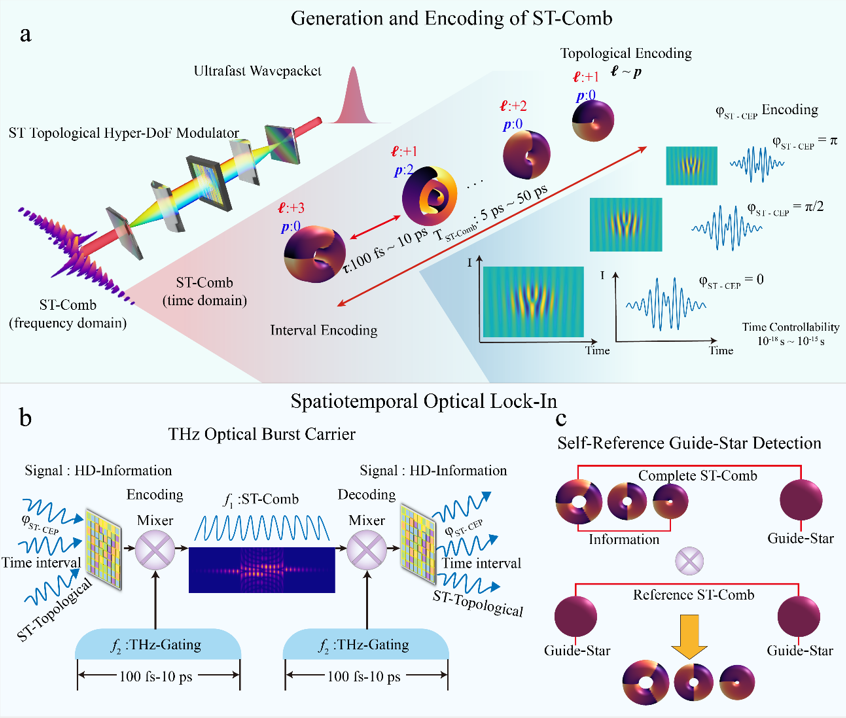
Generation, encoding and self-referenced detection of the ST-Comb.
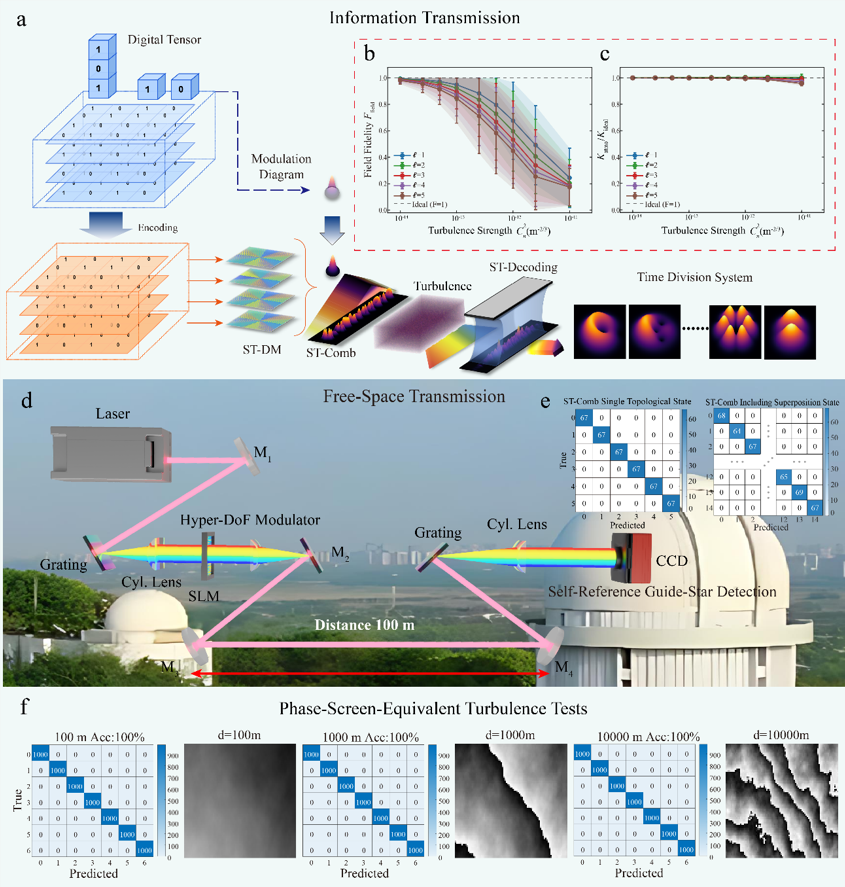
ST-Comb information transmission under outdoor and phase-screen-equivalent turbulence.
FAYETTEVILLE, GA, UNITED STATES, November 3, 2026 /EINPresswire.com/ -- Researchers have introduced a spatiotemporal topological comb (ST-Comb) that shifts high-dimensional optical information into ultrafast THz-scale spatiotemporal-spectral structures while encoding it in recoverable topological fingerprints. The proof-of-concept carries 154 mapped digital bits per wavepacket and remains decodable under phase-screen-equivalent turbulence corresponding to 10 km propagation, offering a route to robust high-dimensional transmission without requiring the local beam profile to remain unchanged.
From AI-model training and data-center interconnects to autonomous driving and low-Earth-orbit satellite networks, data are moving at unprecedented scale. Future communication systems must not only carry more information faster, but also remain accurate and reliable in complex environments. The Shannon-Hartley theorem highlights a basic constraint: at finite bandwidth, channel capacity is tightly linked to signal-to-noise ratio (SNR). As information rates continue to rise, noise, crosstalk and propagation distortions increasingly limit reliable transmission. If conventional communication is like trying to speak through a storm, the intuitive solution is to raise the volume. But there is another question: can information be moved to a region where the storm is weaker? A team led by Guangyu Fan at the University of Shanghai for Science and Technology and Qiwen Zhan at Westlake University offers a different answer. Their spatiotemporal topological comb, or ST-Comb, encodes digital information into femtosecond-to-picosecond ultrafast spatiotemporal structures. Inspired by lock-in detection, useful information is shifted into a THz-scale spatiotemporal-spectral region away from dominant low-frequency technical noise, while optical topology gives each state a stable and distinctive fingerprint. The idea is much like recognizing a melody in a violent storm: every note need not remain perfectly intact, as long as the structure of the melody remains recognizable. In the experiment, the team carried 154 mapped digital bits in a single wavepacket and completed encoding, transmission, reconstruction and recognition even under phase-screen-equivalent turbulence corresponding to 10 km propagation.
At a deeper level, increasing communication capacity means finding more distinguishable and stably readable information states within finite physical resources. Wavelength, polarization and spatial modes have all been used to enlarge this state space, but richer dimensionality usually brings greater field complexity and greater sensitivity to noise and propagation. Spatiotemporal structured light offers a new possibility by jointly organizing space, time and frequency within a single ultrafast wavepacket. Time-varying orbital angular momentum and spatiotemporal optical vortices are representative examples, providing a state space far richer than a single spatial mode. Yet this advantage comes with new fragility: spatiotemporal astigmatism, atmospheric turbulence and propagation distortions can split high-order vortices, couple modes and fragment wavepackets. The challenge is therefore no longer simply how to generate a more complex field, but how to organize information into a scalable high-dimensional state space, obtain a stable reference after propagation, and recover the global physical features that carry information even when the local field has been disturbed. To address this, the team extends topology from a single topological charge to an addressable global spatiotemporal-spectral topological fingerprint, jointly defined by spatiotemporal phase winding, radial topology, coherent topological superpositions and ST-CEP-dependent spectral features. Information is thus distributed across the temporal, spectral and topological structure of the entire wavepacket rather than confined to one instantaneous intensity pattern.
From a vortex mode to a programmable spatiotemporal topological comb. The central idea of the ST-Comb is to divide an ultrafast wavepacket into multiple independently addressable temporal sub-pulses and assign a programmable spatiotemporal topological state to each one. The Hyper-DoF modulation scheme independently controls the amplitude, temporal delay, spatiotemporal topological charge, radial mode and ST-CEP of the sub-pulses, thereby constructing a high-dimensional spatiotemporal-topological parameter space.
Unlike a conventional optical frequency comb that is mainly described by its frequency teeth, the ST-Comb has a two-scale structure in both time and frequency. The sub-pulse spacing ranges from about 100 femtoseconds to 10 picoseconds, corresponding to a sub-terahertz to terahertz primary spectral spacing, while the overall train duration of about 5 to 50 picoseconds produces finer spectral features in the 20 to 200 gigahertz range. Tuning ST-CEP changes the spectral fingerprint while largely preserving the temporal-slot structure, adding another programmable encoding dimension.
154 mapped bits per wavepacket: combining time and topology into a high-dimensional information space. In the proof-of-concept topological-superposition encoding, the researchers use 11 information-bearing temporal slots. Each slot selects from 14 predefined topological modes through a binary mask, corresponding to 14 mapped bits per slot and 154 mapped digital bits per wavepacket. The Gaussian Guide-Star serves only as a reference and is not counted as payload. At the receiver, Guide-Star coherent reconstruction is followed by temporal slicing, after which ST-Net identifies the topological superposition or spectral fingerprint in each slot and maps it back to the encoded bit sequence. The trained model achieved 100 percent classification accuracy on the tested set of 1000 randomly generated ST-Comb samples.
From preserving the beam profile to preserving a recoverable topological fingerprint. Conventional structured-light transmission often aims to keep the received spatial field as close as possible to the transmitted one. Under turbulence, however, beam wander, phase distortion, mode coupling and wavepacket fragmentation are difficult to avoid. The experiments show that local field fidelity decreases as phase-screen-equivalent turbulence becomes stronger, whereas the metric describing the global spatiotemporal-spectral fingerprint remains comparatively stable over the tested range. The ST-Comb therefore does not require every local singularity or intensity feature to remain unchanged; instead, the information-bearing global topological identity only needs to remain recoverable after self-referenced reconstruction.
The team also carried out a real 100 m outdoor free-space transmission experiment at the Sheshan Station of the Shanghai Astronomical Observatory. Controlled phase screens were additionally used to emulate accumulated turbulence corresponding to 100 m, 1 km and 10 km propagation. Across the evaluated outdoor and phase-screen-equivalent datasets, the encoded states were recovered with 100 percent recognition. The 1 km and 10 km cases are equivalent turbulence tests rather than physical outdoor links.
Overall, the ST-Comb establishes a high-dimensional optical information framework in which temporal slots, spatiotemporal phase winding, radial topology, coherent superposition and ST-CEP-dependent spectral fingerprints form a programmable physical alphabet. By combining lock-in-inspired ultrafast-domain encoding with self-referenced coherent reconstruction, the work demonstrates robust encoding, propagation, recovery and intelligent recognition of complex spatiotemporal-topological information in controlled turbulence and real outdoor conditions. More importantly, it suggests a different way to organize optical information: rather than requiring a complex field to preserve its local morphology during propagation, the information-bearing global spatiotemporal-spectral structure is designed to remain recoverable and recognizable. Looking ahead, the ST-Comb could be integrated with on-chip frequency combs, high-speed modulators, programmable metasurfaces and optical phased arrays, and extended to vector spatiotemporal vortices, polarization-structured states and other optical dimensions. Beyond high-dimensional free-space communication, programmable spatiotemporal-topological wavepackets may also provide a platform for ultrafast waveform control, high-dimensional nonlinear optics and emerging frequency-comb technologies.
References
DOI
10.1186/s43593-026-00145-w
Original Source URL
https://doi.org/10.1186/s43593-026-00145-w
Funding Information
This work was supported by the National Key Research and Development Program of China under Grant Nos. 2025YFF0515101 and 2021YFA1400200; the National Natural Science Foundation of China under Grant Nos. 12374318, Z-2025-302-053, 12434012, 62535013, 12450407, 12274091, and 12474336; the Science and Technology Commission of Shanghai Municipality under Grant Nos. 22JC1400200, 24JD1402600, and 24QA2705800; and the Key Project of Westlake Institute for Optoelectronics under Grant No. 2023GD007.
Lucy Wang
BioDesign Research
email us here
Legal Disclaimer:
EIN Presswire provides this news content "as is" without warranty of any kind. We do not accept any responsibility or liability for the accuracy, content, images, videos, licenses, completeness, legality, or reliability of the information contained in this article. If you have any complaints or copyright issues related to this article, kindly contact the author above.
